
Damage seldom arrives through the front door. It slips in at the margins, through a lifted edge along the highest ridge, a hairline crack in a buried pipe, a loose connection behind a wall, or a damp corner where air stops moving. Each of these entry points looks insignificant on its own, and that is exactly what makes them dangerous. Water, heat, combustion byproducts, and electrical current all follow the path of least resistance, and an unattended weak spot becomes a doorway that invites them deeper into the structure.
Protecting a property means thinking like a perimeter defense rather than a repair list. The exterior shell must shed weather, the underground infrastructure must carry waste and supply reliably, the mechanical and electrical core must operate within safe tolerances, and the interior air must stay dry and clean. These defenses overlap, and a breach in one quickly tests the next. Owners who inspect methodically, act on early warning signs, and invest in quality workmanship keep minor vulnerabilities from ever growing into the kind of structural damage that takes hold for good.
Patching Storm-Damaged Shingles and Restoring Ridge Ventilation
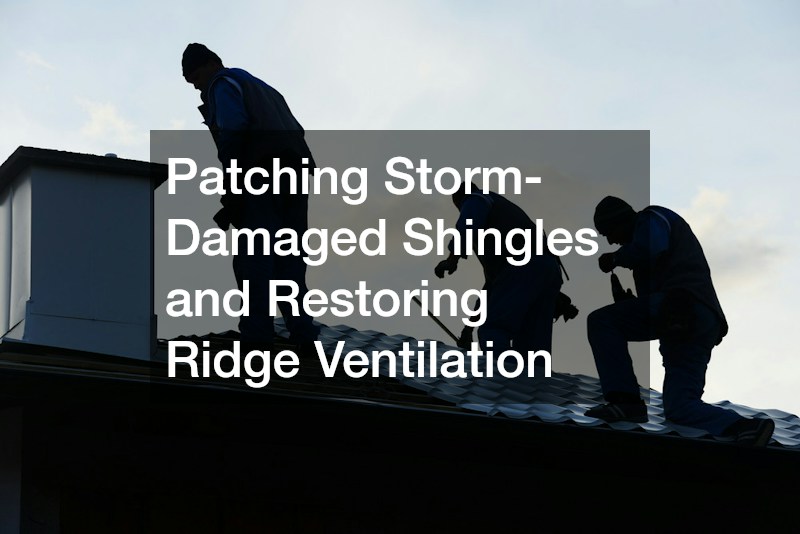
Severe weather inflicts damage that often goes unseen from the ground. Hailstones bruise asphalt shingles and fracture the fiberglass mat beneath the granules, while gusting wind creases tabs upward and breaks their adhesive seal. Once a shingle loses its bond, every subsequent storm can peel it further until it tears free, exposing underlayment and nail heads to direct rainfall. Inadequate attic ventilation compounds these injuries, as trapped summer heat bakes shingles from below and winter condensation drips onto insulation and framing, softening the deck and feeding ice dams along the eaves.
A responsive roofing service begins by documenting every impact and crease with photographs that support an insurance claim, then replaces fractured shingles while carefully lifting and resealing the surrounding courses. Cracked pipe boots are swapped for new neoprene or lead flashing, and soft decking is cut out and renewed. Ventilation receives equal scrutiny. Crews install a baffled ridge vent and clear soffit intakes with insulation baffles, balancing net free area so roughly one square foot of ventilation serves every 150 square feet of attic floor, keeping the assembly cooler, drier, and far more durable.
Flushing Clogged Troughs and Resetting Sagging Hangers
Roof drainage is only as effective as its least maintained section. Leaves, pine needles, seed pods, and loose granules settle into troughs and outlets, forming dense mats that hold standing water. That added weight strains hangers until runs sag, pull away from the fascia, and pitch backward. Overflow then cascades down siding and saturates soil at the foundation, while trapped moisture rots fascia boards and freezes into heavy ice during winter.
Established gutter companies flush every run and downspout with pressurized water, snaking stubborn obstructions from elbows and underground connections. Sagging sections are reset with hidden hangers driven through the fascia into rafter tails using structural screws, and the entire system is re-pitched toward its outlets. Leaking miters and end caps are resealed with elastomeric sealant, rotted fascia is replaced, and micro-mesh guards are fitted to keep debris out and water moving freely.
Scoping Buried Laterals and Replacing Collapsed Sections
The waste line beneath a yard endures pressures that few homeowners consider. Shifting soil, heavy vehicles, and freeze-thaw cycles gradually push buried pipe out of alignment, creating low bellies where solids settle and offset joints that snag debris. Older materials fare worst. Orangeburg fiber pipe softens and flattens like wet cardboard, clay tile cracks under load, and cast iron corrodes until its bottom wall simply disappears. When a section collapses, effluent saturates the surrounding soil, undermines driveways and walkways, and eventually backs up through the lowest drains inside the house.
Precise sewer line repair starts with a locating camera fed through a cleanout, recording the exact depth and position of every belly, break, and collapse. Isolated damage can often be fixed with a sectional point repair, in which a resin-saturated sleeve is cured in place over the failure. Where long stretches have deteriorated, crews may use pipe bursting to pull new HDPE through the old path, or excavate and replace the section with schedule-40 PVC bedded in compacted gravel at proper slope. A final camera pass confirms smooth flow before the trench is closed.
Sweeping Creosote Deposits and Repairing Cracked Flue Liners

Every fire leaves residue behind. As wood smoke cools inside the flue, it condenses into creosote that builds in three stages, from loose soot to flaky deposits to a hard, tar-like glaze that ignites easily and burns hot enough to crack masonry. Clay tile liners also fracture from thermal shock, opening gaps that let heat and combustion gases reach nearby framing. Animal nests, collapsed mortar, and damaged crowns restrict draft, pushing smoke and carbon monoxide back into living spaces.
A certified chimney cleaner performs a camera-assisted inspection to evaluate the full length of the flue, then removes deposits with rotary brushes and specialized chemical treatments that break down glazed creosote. Cracked tile liners are typically relined with insulated stainless steel sized to the appliance, restoring a continuous, code-compliant path for exhaust. A stainless cap blocks rain and wildlife, and a cracked crown is rebuilt or sealed with an elastomeric coating so water can no longer erode the masonry from the top down.
Restoring Booster Pressure and Replacing Worn Impellers
Many homes rely on booster equipment to overcome weak municipal supply, serve upper floors, or feed irrigation and fire sprinkler systems. These centrifugal units spin constantly under load, and their internal components wear out over time. Impellers erode from sediment and cavitation, mechanical seals begin weeping, and bearings grow noisy as lubrication breaks down. As performance declines, showers weaken on upper levels, fixtures surge and fade, and motors overheat while struggling to meet demand.
Experienced water pump services begin by measuring inlet and discharge pressure to quantify the shortfall, then inspect seals, bearings, and impellers for wear. Pitted impellers are replaced, failing mechanical seals are renewed, and suction conditions are corrected to eliminate cavitation. Many systems benefit from upgrading to a variable-speed booster with a small pressure tank, a dependable check valve, and dry-run protection, delivering steady pressure while dramatically reducing motor strain.
Excavating Backyard Basins and Spraying Reinforced Gunite
A backyard swimming area is a massive concrete vessel set into soil that never stops moving. Expansive clay swells and shrinks around the shell, and poorly reinforced structures crack under that stress. When groundwater rises and the basin is drained, hydrostatic pressure can lift an entire shell out of the ground. Leaking underground lines wash away supporting soil, decks heave and separate, and runoff directed toward the house saturates the foundation it was supposed to protect.
Reputable pool builders begin with a soil report and engineered plans, then excavate to precise dimensions and set a grid of steel rebar tied at regular intervals with proper clearance from the soil. Gunite is pneumatically applied to the specified thickness, compacted, and kept moist during its curing period to develop full strength. Hydrostatic relief valves, a continuous equipotential bonding grid, pressure-tested plumbing, and decks sloped away from the house complete a structure built for decades of service.
Squaring Entry Openings and Hanging Insulated Slabs

Entries take daily abuse from weather, traffic, and structural movement. As framing settles, openings rack out of square, slabs bind against jambs, latches fail to engage, and daylight shows around the edges. Worn weatherstripping lets conditioned air escape and drafts enter, while failed threshold seals send rainwater under the sill, where it rots subfloor sheathing and rim joists unseen. A poorly fitted unit also weakens security, since loose jambs and short screws make forced entry far easier.
Professional door installation begins with checking the rough opening for plumb, level, and square, and repairing any rot before the new unit goes in. A sloped sill pan sits beneath the threshold, and flashing tape laps the sides so water drains outward. Shims are set solidly at hinge and strike locations, and long screws anchor the hinges and strike plate deep into framing. Insulated fiberglass or steel slabs, compression weatherstripping, and an adjustable threshold create a tight, secure, energy-efficient seal.
Upgrading Outdated Panels and Rewiring Overloaded Circuits
Electrical systems designed decades ago were never meant to support today’s appliances, chargers, and electronics. Older service sizes struggle under modern loads, and certain legacy panels carry well-known histories of breakers that fail to trip. Overloaded circuits heat their conductors, loose terminals arc, and aluminum branch wiring expands and contracts until connections loosen. These conditions produce flickering lights, warm outlet covers, tripping breakers, and in the worst cases fires that begin inside walls.
Licensed local electrical contractors start with a load calculation to determine whether the service needs an upgrade, often to 200 amps with a new panel and meter base. Circuits are redistributed to balance demand, and AFCI and GFCI protection is added where code requires. Aluminum branch wiring is pigtailed with approved connectors, every terminal is torqued to specification, and a whole-home surge protector shields sensitive equipment. A permit and final inspection verify that the work meets current safety standards.
Containing Fungal Colonies and Drying Saturated Cavities
Microbial growth is always a symptom of a moisture problem. Plumbing leaks, roof seepage, condensation on cold surfaces, and poorly ventilated crawlspaces provide the dampness spores need to colonize drywall paper, wood framing, insulation, and ductwork. Colonies spread unseen inside wall cavities, releasing musty odors and airborne spores that aggravate allergies and respiratory conditions. Prolonged exposure also weakens wood fibers, eventually compromising framing members.
Thorough mold removal services begin with moisture mapping to trace the source and extent of contamination. Technicians seal the work area with polyethylene sheeting and run HEPA-filtered negative air machines to prevent spores from spreading. Porous materials like drywall and insulation are removed and bagged, framing is HEPA-vacuumed and treated with antimicrobial solutions, and dehumidifiers bring relative humidity below 50 percent. Moisture readings and clearance testing confirm success once the original water source has been corrected.
Diagnosing Failed Capacitors and Sealing Leaking Coils

Cooling systems often fail on the hottest afternoon of the year, and the cause is frequently a small, inexpensive part. Run and start capacitors degrade under heat, losing capacitance until motors hum without starting or run hot and inefficient. Meanwhile, refrigerant escapes through corroded evaporator coils, vibrating service valves, or chafed lines. As charge drops, coils freeze, airflow stalls, humidity climbs, and the compressor overheats, risking a far more expensive failure.
Timely air conditioner repairs begin with testing capacitors against their rated microfarad values and replacing any that fall outside tolerance, along with pitted contactors. Technicians then hunt for leaks using electronic detectors and nitrogen pressure tests. Small leaks are brazed while dry nitrogen flows through the tubing, and badly corroded coils are replaced. After a deep vacuum removes moisture, the system is recharged by weight and verified with superheat and subcooling readings.
Keeping Every Line of Defense Strong
A property stays sound when every layer of its defense receives attention before it fails. The shell sheds weather, the drainage network carries runoff and waste away, the combustion and mechanical systems operate within safe limits, and the interior air remains dry and clean. Each of these protections leans on the others. A clogged drainage run soaks the foundation, a leak inside a wall invites microbial growth, and a struggling cooling system lets humidity rise. Damage that begins in one corner rarely stays there.
Consistent preventive care breaks that chain reaction. Seasonal exterior inspections, annual mechanical and combustion checks, periodic camera scopes of buried lines, and routine tests of electrical safety devices reveal problems while they are still inexpensive to fix. Combining those habits with quality materials and code-compliant workmanship extends the life of every component and keeps repair costs predictable instead of overwhelming.
The payoff reaches far beyond the structure itself. A well-defended home is safer to live in, cheaper to operate, healthier to breathe inside, and more valuable at resale. Treating every corner of the property as part of one connected system gives owners lasting confidence that the next storm, heat wave, or busy season will pass without leaving lasting harm behind.